Journal
Decorative Wall Panels: MDF vs PS and Which Suits Each Room
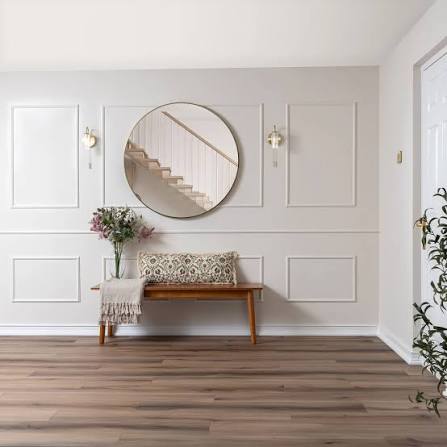
Choosing decorative wall panels is mostly a room decision, not a look decision. The two common panel materials can be finished to look near identical, and they behave nothing alike once they are on a wall.
MDF is rigid, takes paint beautifully and holds a crisp profile. PS, meaning polystyrene, is lightweight, tolerates moisture and cuts more easily around obstructions.
Put MDF in a bathroom and the edges will tell you about it within a couple of years. Put PS on a formal dining wall and you lose some of the definition MDF gives you. This guide covers the difference properly, room by room.
What panels actually solve
Worth being clear about the problem before the materials, because panels are frequently chosen for the wrong reason.
An uneven wall. This is the strongest practical case. Older homes across Northern Virginia frequently have plaster over lath, and plaster is rarely flat. Paint shows every wave and patched repair once light rakes across it. A flat wallcovering does the same. Panels sit proud of the wall and cast their own shadows, so the surface behind them stops being the thing you notice.
A wall with no architectural interest. A long blank wall in a new-build room. Panels give it proportion and a reason to look at it.
Wear at contact height. Panelling to chair rail height in a hallway, a stairwell or a dining room takes the knocks that paint shows.
Acoustic softening, to a limited extent. Panels break up a flat reflective surface, which helps slightly in a room that echoes. They are not an acoustic treatment and should not be sold as one.
What panels do not solve is a wall with a moisture problem. Covering damp is covering damp, whatever the material.
[IMAGE: raking light across a plastered wall showing surface irregularity, alongside the same wall panelled]
MDF and PS compared
MDF
PS (polystyrene)
Composition
Compressed wood fibre with resin
Extruded polystyrene foam
Rigidity
High
Low, flexible
Weight
Heavy
Very light
Moisture tolerance
Poor, swells if the edge is breached
Excellent, unaffected
Profile definition
Crisp, sharp arrises
Softer, slightly rounded
Paint finish
Excellent, takes any paint
Good, requires compatible paint
Cutting
Power tools, produces fine dust
Sharp blade, minimal mess
Fixing
Adhesive plus fixings
Adhesive alone in most cases
Cutting around obstructions
Slower, less forgiving
Fast, very forgiving
Impact resistance
Good
Lower, dents rather than chips
Typical cost
Higher
Lower
Where MDF wins
Definition. A moulded MDF profile holds a sharp edge. In a formal room with good light, that crispness is visible and it is the reason MDF remains the default for dining rooms, studies and stair runs.
Impact resistance. A hallway takes knocks from bags, vacuum cleaners and furniture. MDF resists that better than foam does.
Paint behaviour. MDF takes paint as well as any substrate. It can be sprayed, brushed, and it holds a high sheen without telegraphing the surface beneath.
Where PS wins
Moisture. This is the decisive one. Polystyrene is unaffected by humidity, which makes it the correct choice in a bathroom, a basement, a laundry room or anywhere with a damp history.
Weight and handling. PS panels can be fixed with adhesive alone in most cases, which means no visible fixings to fill and a faster installation.
Cutting around obstructions. A wall with sockets, switches, a radiator bracket and an awkward return is far quicker in PS, because the material cuts with a blade rather than a saw and forgives an imperfect cut.
Cost. Both material and installation are generally lower.
The moisture question, in detail
This is where the wrong choice becomes visible, so it is worth understanding the mechanism.
MDF is wood fibre bound with resin. The faces are sealed by the finish, but every cut edge exposes raw fibre. When that fibre absorbs moisture it swells, and the swelling does not reverse when it dries. The panel face lifts slightly at the edge and the joint opens.
In a dry room that never happens. In a bathroom, the cycle of steam and drying repeats several times a day.
The EPA recommends keeping indoor relative humidity below 60 percent and ideally between 30 to 50 percent. A bathroom without extraction running, or with a fan that vents into a roof space rather than outside, sits above that range every time someone showers. That is the condition MDF is poor in and PS is indifferent to.
Where the line falls in practice:
Room
Recommended
Dining room, study, living room
MDF
Hallway and stairs
MDF
Bedroom
MDF
Bathroom, shower room, cloakroom
PS
Kitchen, away from the splash zone
MDF acceptable, PS safer
Laundry or utility room
PS
Basement, below grade
PS
Conservatory or sun room
PS, because of temperature swing as well as humidity
Sealing edges is a partial answer, not a solution. A well-sealed MDF edge lasts considerably longer than an unsealed one, and in a room with reliable extraction it may be fine indefinitely. It is a risk reduction rather than an elimination, and in a basement or a family bathroom it is not enough on its own.
Panel styles and where each suits
The material decision and the style decision are separate, and both are available in either material.
Shaker or square panelling. Clean rectangular frames, most versatile, suits almost any room. Reads as contemporary or traditional depending on proportion and paint colour.
Board and batten. Vertical battens over a flat field. Reads as informal and rural, suits hallways, mudrooms and bedrooms.
Slat panelling. Evenly spaced vertical slats, usually on a backing board. Strongly contemporary and the style most requested currently. It also does the most for acoustics of any panel style, though still modestly.
Beaded or tongue and groove. Traditional, suits period homes and cottages, and it is the style most likely to look wrong in a new-build.
Fluted or reeded. Narrow half-round profiles, contemporary, and the profile definition question matters most here. Fluting in MDF holds a crisper shadow line than fluting in PS.
Wainscot height. Roughly a third of the wall height is the conventional proportion, which typically lands around chair rail. Full-height panelling reads as more formal and makes a room feel taller. Panelling to two thirds height is the least common and usually the least successful.
Our full product range covers the styles available in both materials.
Installation, and what the wall has to do first
Panels hide an uneven wall. They do not hide a wall that is failing.
Sound substrate. Loose plaster, blown areas and crumbling patches get repaired before anything is fixed to them. A panel adhered to a failing surface takes the surface with it when it moves.
Dry. A wall with a damp problem is diagnosed and fixed first. Panelling over damp traps it.
Primed where necessary. Adhesive does not bond well to a glossy surface. A wall in eggshell or gloss gets scuffed and primed before installation rather than after the material has arrived.
Fixing method by material. PS is typically adhesive only, which leaves nothing to fill. MDF usually takes adhesive plus fixings into studs, and those fixings are filled and sanded before painting.
Scribing. In an older home the wall is rarely plumb and the floor is rarely level. Panels are scribed to follow the actual line rather than forced to a square one. It takes longer and it is what separates a fitted result from an approximate one.
Painting. MDF takes standard decorating paints. PS requires a compatible paint, since some solvent-based products attack polystyrene. This is worth confirming before buying paint rather than after.
Our guide to wall preparation before installation covers what a wall needs in more detail.
Durability, cleaning and how each ages
Worth knowing before choosing, because the two materials wear differently.
MDF over time. A painted MDF panel in a dry room ages like any painted joinery. It marks, it can be washed, and it repaints cleanly. Where it fails is at a breached edge: a chip at floor level that exposes raw fibre, then a mop, then swelling. The fix is to seal any damage promptly rather than to leave it.
PS over time. Polystyrene does not swell, rot or absorb. It dents rather than chips, and a dent in foam does not recover the way a knock in timber sometimes does. In a low-traffic room that rarely matters. In a hallway with bags and a vacuum cleaner, it is the trade-off you are accepting for the moisture tolerance.
Cleaning both. Mild detergent and a damp cloth. Avoid solvent cleaners on PS entirely, and avoid soaking either at a joint or an edge.
Repainting. MDF repaints indefinitely. PS repaints with compatible products, and each additional coat slightly softens profile definition, so a panel repainted several times loses some of the crispness it started with.
Skirting and where panels meet the floor. This is where most panel failures begin. A panel that runs to the floor sits in the path of mopping, vacuuming and spills. Running panelling down to a skirting board rather than to the floor itself puts a sacrificial, replaceable element at the point of highest risk, and it is worth specifying in any room where the floor gets wet.
What it costs and what drives it
Panelling is one of the few interior upgrades where the material is a modest share of the cost and the labour is most of it.
What moves the number:
Wall area and the number of openings. A plain rectangular wall is quick. The same area broken by two windows, a radiator and three sockets takes considerably longer, and that is where PS earns some of its cost back through faster cutting.
Height. Wainscot to chair rail is roughly a third the area of full height, and less than a third the labour, since the top rail does a lot of the finishing work.
Profile complexity. A flat shaker field is the quickest. Fluting, beading and fine slat spacing all take longer to set out and longer to finish.
Stair runs. The most labour-intensive application there is, because every panel meets the string at an angle and nothing repeats.
Finish. Panels supplied primed and painted on site is the common route. Spray finishing gives a better result and adds cost, and it is worth it on a full-height formal wall in a way it rarely is on a hallway dado.
Substrate repair. Frequently the item nobody budgets for. A wall that needs plaster repair before panelling adds a trade and a drying period.
Panels alongside wallcovering
The two are frequently used together and the combination works when the division is deliberate.
Panels below, wallcovering above. The most common arrangement. Panelling to chair rail takes the wear, wallcovering above carries the pattern. The rail is the transition and it should be a considered detail rather than a strip of moulding chosen last.
Panels on one wall, wallcovering on the others. Works where the panelled wall is the focal wall, usually behind a bed or a fireplace.
Both on the same wall in separate zones. Rarely successful. The eye reads competition rather than composition.
A practical point on ordering: if you are combining, order both at the same time. Wallcovering comes in dye lots and a top-up order weeks later will not match, which is covered in our wallpaper calculator guide.
How much to order
Panels are sold by the panel or by the square foot depending on the system, which makes the calculation simpler than wallcovering but not trivial.
Measure each wall separately rather than using room dimensions, since rooms are rarely square and alcoves and chimney breasts add real area.
Subtract full-height openings only. A door is worth subtracting. A small window in the middle of a panelled field is not, because the panels still have to be cut around it and the offcuts are rarely usable.
Allow for cutting waste. Ten percent on a straightforward room. Fifteen where there are many openings, an irregular ceiling line, or a stair run, since a stair is the highest-waste application there is.
Order the whole room at once. Even where there is no pattern to match, batch variation in colour and profile depth exists, and a later top-up may not blend.
[IMAGE: panelled stair run showing the raked cut against the string]
Frequently asked questions
What is the difference between MDF and PS wall panels?
MDF is compressed wood fibre, rigid, and it holds a crisp profile but swells if moisture reaches a cut edge. PS is extruded polystyrene, lightweight, flexible and unaffected by humidity, with a slightly softer profile. Finished, they can look near identical. In a wet room they behave completely differently.
Can you use MDF wall panels in a bathroom?
It is not the safer choice. Every cut edge exposes raw fibre, and repeated steam cycles cause swelling that does not reverse. Sealing the edges reduces the risk substantially but does not eliminate it. In a family bathroom or a room with poor extraction, PS is the better material.
Are wall panels good for uneven walls?
Yes, and it is their strongest practical case. Panels sit proud of the wall and cast their own shadows, so surface irregularity stops being visible. What they cannot do is hide a wall that is failing or damp, both of which are repaired first.
How high should wall panelling be?
Roughly a third of the wall height is the conventional proportion and typically lands near chair rail. Full-height panelling reads as more formal and makes a room feel taller. Two thirds height is the least common proportion and usually the least successful.
Do wall panels help with sound?
Modestly. They break up a flat reflective surface, which reduces echo slightly, and slat panelling does most of the little that is available. They are not an acoustic treatment and should not be relied on as one.
Can you paint PS wall panels?
Yes, with a compatible paint. Some solvent-based products attack polystyrene, so the paint is confirmed before purchase rather than after. MDF takes standard decorating paints without restriction.
How much extra should I order?
Ten percent on a straightforward room, fifteen where there are many openings, an irregular ceiling line or a stair run. Order the whole room in one go, since batch variation in colour and profile depth exists even without a pattern to match.
Can wall panels be installed over wallpaper?
Not reliably. Adhesive bonds to the wallpaper rather than to the wall, and the panel is only as secure as the paper behind it. Existing wallcovering comes off and the wall is prepared before panelling goes on.
Choosing for your room
The sequence is straightforward. Decide the room, which decides the material. Then choose the style, which is a free choice in either. Then prepare the wall, which is what determines whether the result lasts.
If the room is dry and formal, MDF gives you the crisper result. If there is any moisture in the picture, PS removes a risk that no amount of edge sealing fully addresses.
Tell us the room and we will send samples of the right material rather than the whole range. You can request samples online, browse the full collection, or get in touch with your wall dimensions.
Trade professionals can register for a dealer account for project specification support.