Journal
Wallpaper in Bathrooms and Kitchens: What Actually Holds Up
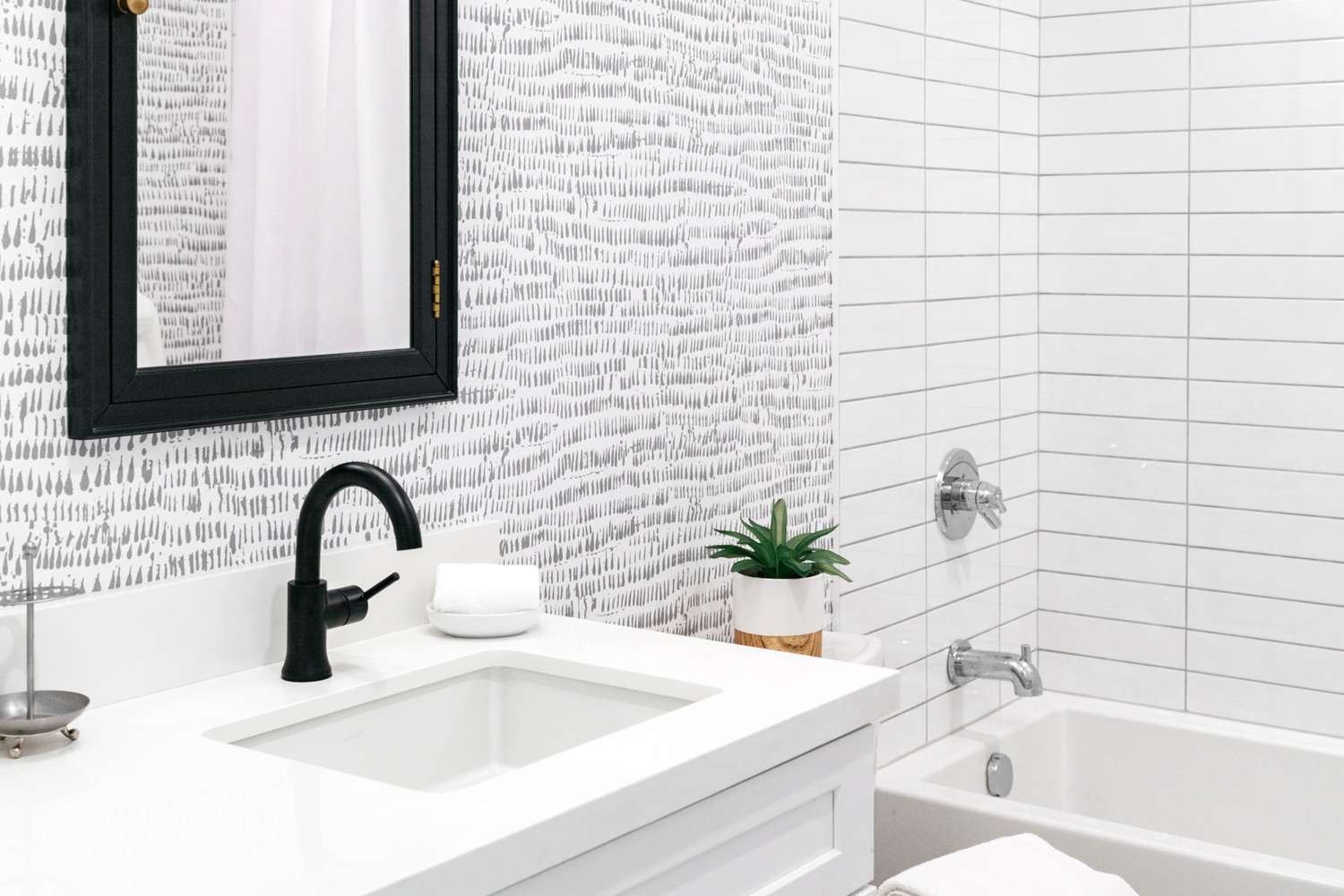
Bathroom wallpaper fails for one of three reasons, and none of them is that wallpaper cannot go in a bathroom. It fails because the wrong material was chosen, because the wall underneath was not prepared, or because it was installed somewhere that no wallcovering survives.
Get those three right and a bathroom or kitchen wallcovering lasts as long as one anywhere else in the house. Get any of them wrong and it lifts at the seams within a season, which is where the reputation comes from.
This guide covers what actually holds up in a wet or greasy room, how to read the durability information on a product, what the wall needs before anything goes on it, and the handful of places where the honest answer is to use something other than wallpaper.
Why these rooms are different
Three things are happening in a bathroom or a kitchen that are not happening in a bedroom.
Humidity cycling. A bathroom goes from ambient to near saturation and back several times a day. It is the cycling that stresses an adhesive bond rather than the peak humidity itself, because the substrate and the covering expand and contract at different rates.
Direct water. Splashes near a basin, spray near a shower, condensation running down a cold wall.
Heat and grease, in a kitchen. Airborne cooking residue settles on every surface in the room and it requires cleaning, which means the wallcovering has to tolerate being washed rather than wiped.
Ventilation changes all three. The US Environmental Protection Agency recommends keeping indoor relative humidity below 60 percent, and ideally between 30 and 50, to control mold growth. A bathroom with a working extractor that runs during and after a shower is a very different environment from one with a painted-over vent, and the same wallcovering will perform differently in each.
If the extraction is inadequate, fixing that comes before choosing a wallcovering. No material compensates for a room that stays wet.
What holds up
Vinyl wallcoverings
The reliable choice for wet and working rooms, and what most commercial specifications use for the same reason.
A vinyl wallcovering has a vinyl face over a backing, so the surface that faces the room is a continuous non-absorbent film. It tolerates humidity, it can be washed rather than only wiped, and it is dimensionally stable through the cycling that lifts paper products.
Vinyls are classified by durability, and the industry test method ASTM F793 sets out categories from decorative through to heavy duty based on washability, scrubbability, abrasion, tear and adhesion. The classification is the most useful single piece of information on a specification sheet, and it is worth asking for rather than relying on a general description.
For a family bathroom or a kitchen, a covering rated for scrubbing rather than only for washing is the sensible floor.
Non-woven wallcoverings
A blend of natural and synthetic fibres, dimensionally stable, and breathable in a way that solid vinyl is not.
Non-wovens are easier to hang and easier to remove than traditional paper, since they strip dry in full sheets rather than needing to be soaked and scraped. In a bathroom with good ventilation they perform well, and the breathability is an advantage on an exterior wall where trapped moisture is a concern.
They are less tolerant of direct water than a vinyl. This is a good choice for a powder room or a well-ventilated full bathroom, and a less good one for a room where the walls get wet.
Vinyl-coated paper
A paper substrate with a vinyl coating on the face. A middle option: more moisture-tolerant than plain paper, less durable than a true vinyl.
Reasonable for a powder room. Not the choice for a bathroom with a shower in it or a kitchen wall near a range.
What to avoid in these rooms
Uncoated papers, including most traditional printed papers. They absorb moisture, expand, and release at the seams.
Grasscloth and other natural fibre coverings. Beautiful, and entirely wrong for a wet room. Natural fibres absorb moisture and stain permanently from splashes, and the texture holds cooking residue in a kitchen. Grasscloth belongs in a dining room or a study.
Anything unsealed with a delicate face, including silks, flocks and delicate metallics, unless the room is a powder room with no shower and light use.
Where wallpaper should not go at all
Being direct about this saves disappointment.
Inside a shower or above a bath surround. Nothing in the wallcovering category belongs on a surface that takes direct water. That is a job for tile, stone or a panel system.
Directly behind a range or a sink. The splash zone needs a washable hard surface. A backsplash of tile or panel, with the wallcovering starting above it, is the correct detail.
On a wall with an existing damp problem. A wallcovering over damp traps the moisture and the problem gets worse out of sight. The damp has to be resolved first, and this is not negotiable.
On a cold exterior wall in a room with poor ventilation, where condensation forms on the wall surface. This is a building physics problem rather than a wallcovering problem, and a vinyl covering on it can make things worse by preventing the wall from drying inward.
The wall underneath decides the outcome
More installations fail from preparation than from product choice.
Clean. Kitchens in particular need degreasing before anything goes on the wall. Airborne cooking residue is a release agent, and an adhesive will not bond through it.
Sound. Loose or flaking paint, failed previous adhesive, and blown plaster all have to be dealt with. A covering is only as well attached as what it is attached to.
Filled and sanded. Any flat or lightly textured covering shows the wall through it, and a raking light in a bathroom is unforgiving. This is more important than people expect, and it is why a good installer spends more time on the wall than on the hanging.
Primed. A wallcovering primer does two jobs: it gives the adhesive a consistent surface to bond to, and it makes future removal far easier. Skipping the primer is the reason some wallpaper takes the paper face of the drywall with it when it comes off, which turns a decorating job into a repair job.
Dry. New plaster and new drywall compound need to be fully dry before priming. This takes longer than the schedule usually allows and it is worth waiting for.
What is underneath also determines how the old covering comes off. Older homes in this area frequently have wallpaper applied directly to unprimed drywall, and removing it damages the board. Plaster over lath is more forgiving of removal and less forgiving of what it reveals: hairline cracks, previous patches and an uneven surface that any flat material will show.
Testing a small area in a corner before committing to a date tells you which situation you are in. Ten minutes there is the difference between planning a weekend and discovering a fortnight.
Practical decisions in these rooms
Start above the backsplash in a kitchen, and above the tile or the splash zone in a bathroom. This is the standard detail and it works because the wallcovering never sees direct water.
A powder room is the best candidate in the house for something bold. It is small, so the material cost is low, it has no shower, and it is a room people spend a short time in, which means a pattern that would be overwhelming elsewhere works there.
Consider the ceiling in a small bathroom. A covering taken onto the ceiling in a powder room reads as deliberate and makes a small space feel enclosed in a good way. It needs a product and an adhesive suited to it.
Seams away from wet areas. Where the layout allows, plan the drop positions so seams do not land immediately beside a basin or at an external corner that gets knocked.
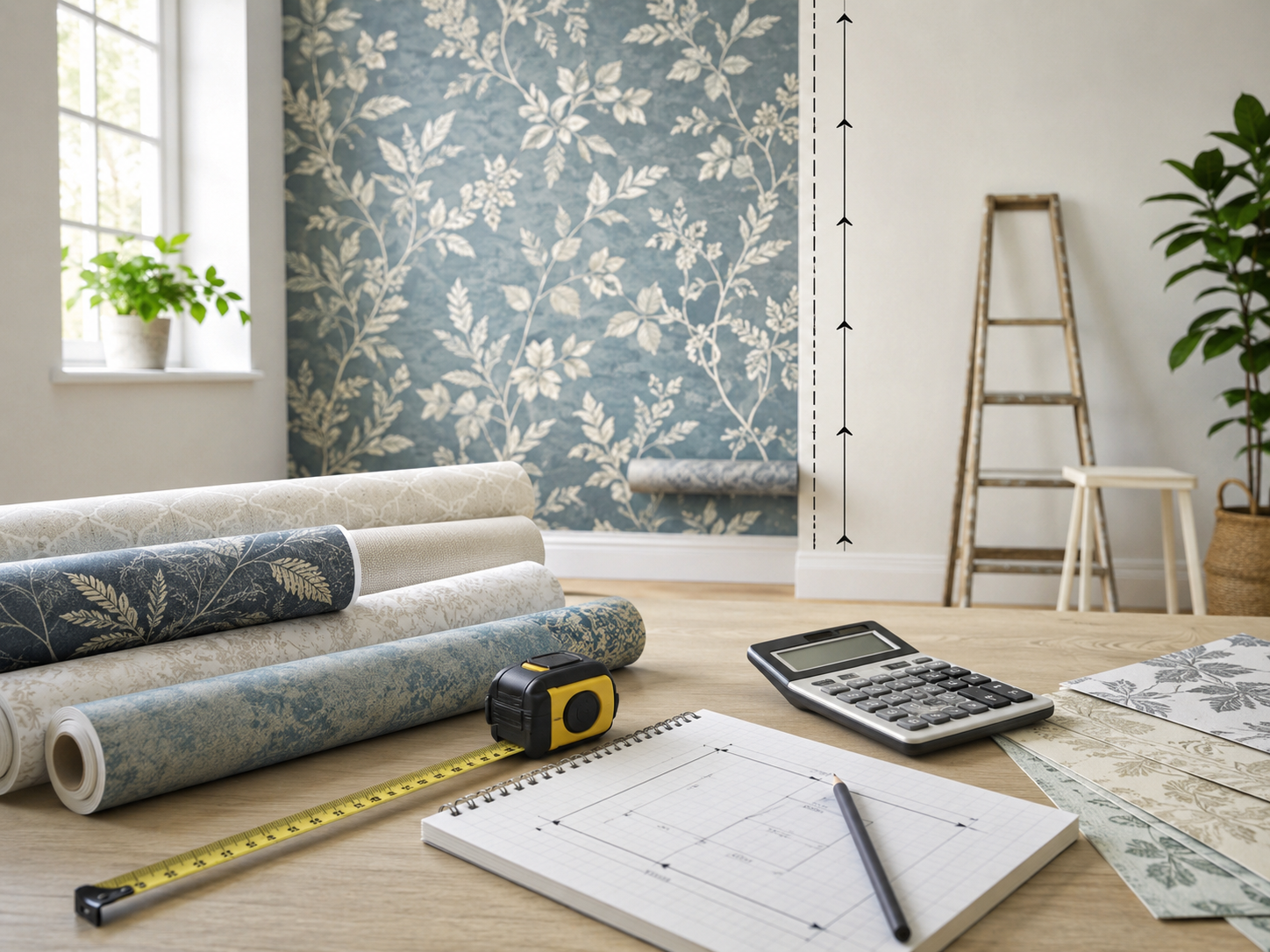
Order the full quantity at once. Material ordered short and topped up later is not guaranteed to match, since dye lots vary. On a small room a partial match is more obvious than it would be on a large one, because every wall is in view at the same time. Our wallpaper calculator covers how to work out the quantity with the correct overage for the pattern repeat.
Keep a spare roll. Bathrooms and kitchens take knocks, and a small repair from matching stock is straightforward. A repair from a different dye lot is not.
Pattern and scale in a small room
Bathrooms and powder rooms are small, and small rooms change how a pattern reads.
A large-scale pattern in a small room works better than most people expect. The instinct is to choose something small and unobtrusive, and the result is often busy rather than calm, because a small repeat across four close walls produces a lot of visual incident. A large pattern with generous negative space reads as quieter in the same room.
Consider how many full repeats you will actually see. In a powder room with a wall barely wider than the repeat, you may see one and a half repeats on the main wall. That means the pattern is functioning as a composition rather than as a texture, and where it lands matters.
Think about the fixtures. A basin, a mirror and a toilet interrupt the walls at fixed heights. A pattern with a strong horizontal element can end up cut awkwardly by them, and it is worth holding a sample against the wall at the real height rather than judging it flat on a table.
Light changes everything, and bathrooms frequently have no natural light at all. A covering chosen under showroom lighting can read quite differently under a single warm ceiling fixture. This is the main reason to take samples home and look at them in the actual room at the times of day you use it.
In a kitchen, the pattern competes with more. Cabinets, backsplash, appliances and open shelving already occupy the visual field, so the wallcovering usually does better as a quieter element than as the feature. The exception is a dining area within an open-plan kitchen, where the covering can do more work because there is less around it.
Cleaning and maintenance
Washable and scrubbable are different ratings and the difference matters here. Washable means it tolerates a damp sponge. Scrubbable means it tolerates a brush and a cleaning solution. A kitchen wall near a cooking zone needs the second.
For routine care, a soft cloth with mild soap and water handles most marks on a vinyl. Abrasive cleaners and solvents damage the surface finish, and once the finish is gone the covering stains readily.
In a kitchen, cleaning the wall periodically rather than waiting for visible marks keeps the surface from building up a film that becomes difficult to remove.
Commercial and high-traffic settings
The same principles apply in a restaurant washroom, a hotel bathroom or a commercial kitchen area, with the durability requirement raised considerably.
Specification moves up the ASTM F793 categories. A residential bathroom is served by a scrubbable covering. A commercial washroom with continuous use needs a heavier duty classification, because the failure mode there is abrasion and cleaning damage rather than moisture alone.
Cleaning protocols are harsher. Commercial cleaning uses stronger agents and more frequent application than domestic cleaning does, and a covering specified for a home will not survive it. Ask what the cleaning regime will be before specifying, not after.
Fire performance may be required. Commercial settings frequently carry requirements for the flame spread and smoke development characteristics of interior finishes, and these vary by occupancy type and jurisdiction. This is a question for the project's code consultant, and the relevant test data should come from the manufacturer for the specific product.
Damage tolerance matters more than appearance. In a high-traffic setting, the question is not only how the covering looks when installed but how it looks after two years of trolleys, bags and shoulders against it. A wall panel system frequently outperforms any covering at the impact-prone lower level, with a wallcovering above it.
Frequently asked questions
Can you put wallpaper in a bathroom?
Yes, with the right material and adequate ventilation. A vinyl wallcovering rated for scrubbing handles a family bathroom. Non-wovens suit well-ventilated bathrooms and powder rooms. What does not work is an uncoated paper, a natural fibre covering such as grasscloth, or any covering on a surface that takes direct water.
What kind of wallpaper is best for a kitchen?
A vinyl wallcovering with a scrubbable rating, because kitchen walls collect airborne cooking residue and need washing rather than wiping. The covering should start above the backsplash so it never sees direct splashes from the sink or the range.
Will wallpaper peel in a bathroom?
Not if the material, the ventilation and the wall preparation are right. Peeling at the seams is nearly always one of three things: an absorbent covering in a humid room, an extractor that does not run long enough, or an unprimed or unclean wall that the adhesive could not bond to. Fixing the ventilation matters more than any product choice.
Do I need a primer before hanging wallcovering?
Yes, and it is the step most often skipped. A wallcovering primer gives the adhesive a consistent surface and makes future removal far easier. Without it, removal can pull the paper face off the drywall, which turns redecorating into a repair.
Can wallpaper go over tile?
Not directly, and not reliably. The grout lines telegraph through and the glazed surface gives an adhesive very little to bond to. The tile would need to be skimmed flat and primed first, at which point removing the tile is often the better answer.
How do I know if a wallcovering is durable enough?
Ask for the classification rather than relying on a general description. Vinyl wallcoverings are tested under ASTM F793 and classified by washability, scrubbability, abrasion and tear resistance. For a bathroom or a kitchen, look for a scrubbable rating, and for a commercial or heavy-use setting look at the heavier duty categories.
Choosing yours
Wallcovering in a bathroom or a kitchen is a straightforward proposition once the material is matched to the conditions. A scrubbable vinyl above the splash zone, on a wall that has been cleaned, filled and primed, in a room that ventilates properly, will perform for years. The failures come from putting a decorative product into a working environment and hoping.
Morek Interiors supplies wallcoverings, wall panels and murals from our Fairfax showroom, working with homeowners, designers and contractors across the region.
Browse the product range and the categories, including wall panels where a hard-wearing surface suits the room better than a covering would. Request samples to see materials against your own light and finishes, and bring a photograph of the wall so we can advise on what it will take.
Designers, contractors and stagers can register for a trade account. To visit the showroom or discuss a specification, contact us, and you can read more about our work.